We use cookies to ensure you get the best experience on our website. For more information on how we use cookies, please see our cookie policy.
By clicking "Accept", you agree to our use of cookies.
Learn more.
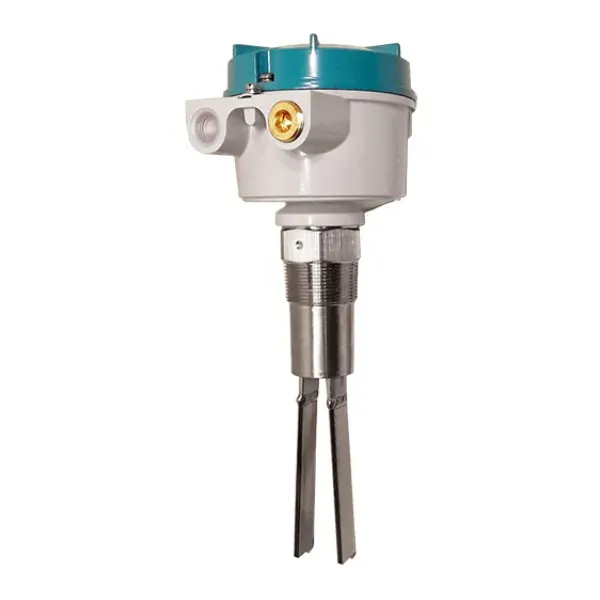
SITRANS LVS200 is a vibrating point level switch designed for high, low, or demand level detection of bulk solids. It is available in standard and liquid/solid interface versions, with an optional low-density configuration.
The standard LVS200 detects high, low, or demand levels of dry bulk solids in bins, silos, or hoppers. The liquid/solid interface version can also detect settled solids within liquids or solids within confined spaces such as feed pipes. It is designed to ignore liquids in order to detect the interface between a solid and a liquid.
A pipe extension version is available with either the standard or liquid/solid interface electronics and fork, separated by a customer supplied 1 inch pipe.
SITRANS LVS200 has an optional 4 to 20 mA output for monitoring build-up on the fork to determine when preventative maintenance should be performed in sticky applications.
The LVS200 has a compact design and can be top, side, or angle mounted. The vibrating fork design ensures the tines are kept clean. The unique design of the fork and crystal assembly eliminates false high level readings even if tines become damaged.
A signal from the electronic circuit excites a crystal in the probe causing the fork to vibrate. If the fork is covered by material, the change in vibration is detected by the electronic circuitry which causes the relay to change state after a one second delay. When the fork is free from material pressure, full vibration resumes and the relay reverts to its normal condition.
Key Applications: dry bulk solids in bins, silos, hoppers or settled solids within liquids (interface version).
| Mode of operation - Measuring principle | Vibrating point level switch |
|---|---|
| Input - Measured variable | High, low, and demand |
| Measuring frequency - Standard | 125 Hz |
| Measuring frequency - Liquid/solid interface and short fork version | 350 Hz |
| Output - PNP | Open collector: Permanent load max. 0.4 A, short-circuit and overload protected Turn-on voltage: max. 50 V (reverse protection) |
| Output - 2-wire without contact | Load current: Min. 10 mA Max. 500 mA permanent Max. 2A < 200 ms Max. 5A < 50 ms Voltage drop on the electronic module: max. 7 V with closed electric circuit Cut-off current with open electric circuit: max. 5 mA |
| Output - Relays - Version with 1 relay | SPDT relay |
| Output - Relays - Version with 2 relays | DPDT relay |
| Output - Relay delay | From loss of vibration: approximately 1 second From resumption of vibration: approximately 1 ... 2 seconds |
| Output - Signal delay | Probe uncovered to covered: approximately 1 second Probe covered to uncovered: approximately 1 ... 2 seconds |
| Output - Relay fail-safe | High or low, switch selectable |
| Output - Alarm output | Relay 8 A at 250 V AC, non-inductive Relay 5 A at 30 V DC, non-inductive |
| Output - mA output | 8/16 mA or 4 ... 20 mA Resolution: 4 ... 20 mA ± 0.1 mA |
| Sensitivity | High or low, switch selectable |
| Rated operating conditions - Location | Indoor/outdoor |
| Ambient conditions - Ambient temperature | ‑40 ... +60 °C (‑40 ... +140 °F) |
| Ambient conditions - Storage temperature | ‑40 ... +80 °C (‑40 ... +176 °F) |
| Ambient conditions - Installation category | III |
| Ambient conditions - Pollution degree | 2 |
| Medium conditions - Process temperature (All except CSA Class II, Group G) | -40 ... +150 °C (-40 ... +302 °F) |
| Medium conditions - Process temperature (CSA Class II, Group G) | -40 ... +140 °C (-40 ... +284 °F), CSA temperature code T3B |
| Medium conditions - Max. threaded bushing temperature | 80 °C (176 °F) |
| Medium conditions - Max. enclosure surface temperature (Category 2D) | 90 °C (194 °F) |
| Medium conditions - Max. extension surface temperature (Category 1D) | 150 °C (302 °F) |
| Medium conditions - Pressure (vessel) | Max. 30 bar g (435 psi g) European Pressure Directive 2014/68/EU: Category 1 |
| Medium conditions - Minimum material density - Standard version | approx. 20 g/l (1.2 lb/ft³) |
| Medium conditions - Minimum material density - Liquid/solid interface version | approx. 50 g/l (3 lb/ft³) |
| Medium conditions - Minimum material density - Optional low density version | approx. 5 g/l (0.3 lb/ft³) |
| Design - Material - Enclosure | Epoxy coated aluminium |
| Design - Material - Process connection | Thread 1½" NPT [(Taper), ANSI/ASME B1.20.1], R ½" [(BSPT), EN 10226], and flange options Optional sliding bushing with 2" NPT [(Taper), ANSI/ASME B1.20.1] or BSP thread Thread material: stainless steel 303 (1.4301) |
| Design - Material - Tine material | Stainless steel 316L (1.4404), PTFE-coated tines are available upon special request |
| Design - Degree of protection | IP65/Type 4/NEMA 4 |
| Design - Conduit entry | 2 x M20 x 1.5 or 2 x ½" NPT (For FM and CSA approved versions only.) |
| Design - Weight - Standard version, no extensions | approx. 2.0 kg (4.4 lb) |
| Design - Weight - Solids/liquids version, no extensions | approx. 1.9 kg (4.2 lb) |
| Power supply | 19 ... 230 V AC, +10 %, 50 ... 60 Hz, 8 VA 19 ... 55 V DC, +10 %, 1.5 W |
| Certificates and approvals - General Purpose | CSA/FM |
| Certificates and approvals - CE | Yes |
| Certificates and approvals - Dust Ignition Proof | CSA/FM |
| Certificates and approvals - RCM | Yes |
| Certificates and approvals - ATEX | II 1/2 D |
| Certificates and approvals - Intrinsically Safe | CSA/FM Class I, II, III Div. 1, Groups A, B, C, D, E, F, G, FM Class I, Aex ia IIC, CSA Class I, Ex ia IIC (available only with power supply options 5 and 6) ATEX II 1G and 1/2 G Eex ia IIC; ATEX II 1D and 1/2 D (available only with power supply option 5) |
Technical documents and specifications for this product.
Siemens LVS 200
